How a Poulsbo Comfort Dog and a Local Veterinary Hospital Are Redefining Community Care
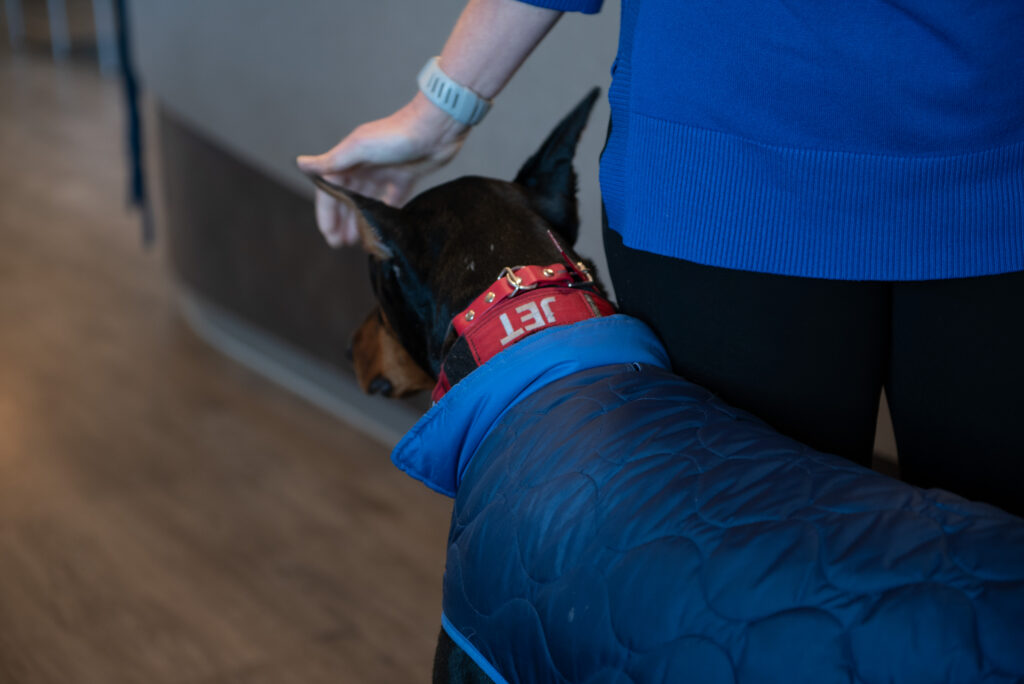
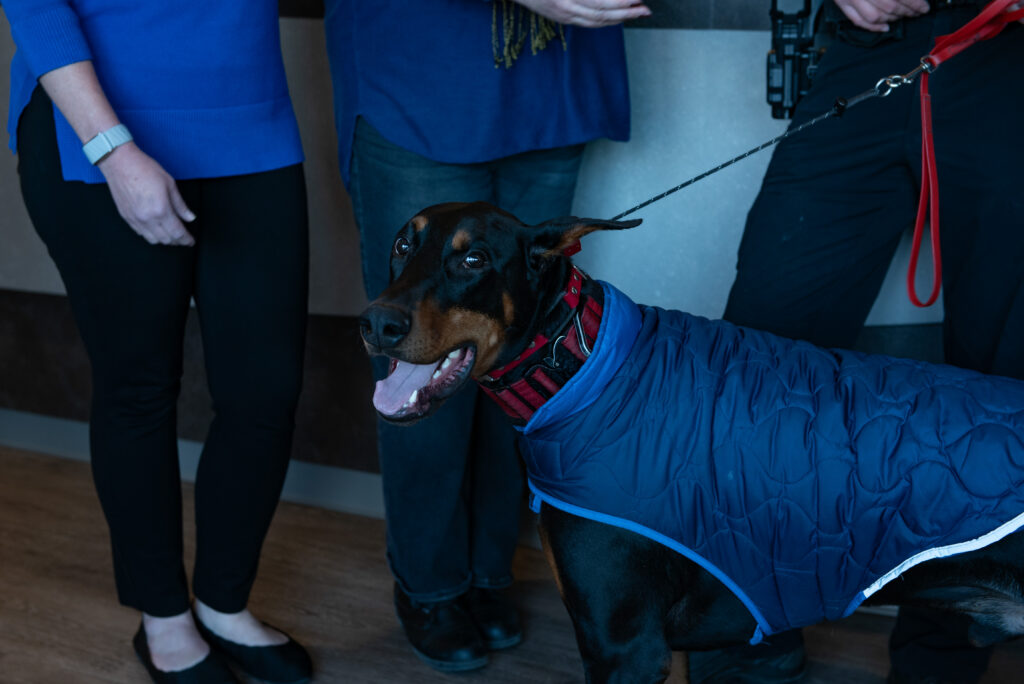
The first thing most people notice about Jet is his size. The sleek, muscular Doberman looks every bit the serious working dog. But within seconds, that impression softens. Jet nudges a hand for attention, leans his full weight into a leg to snuggle, or settles squarely into a lap as if he’s known the person forever. Whatever assumptions people bring with them—about police dogs, Dobermans, or even law enforcement itself—rarely survive their first encounter with Jet.
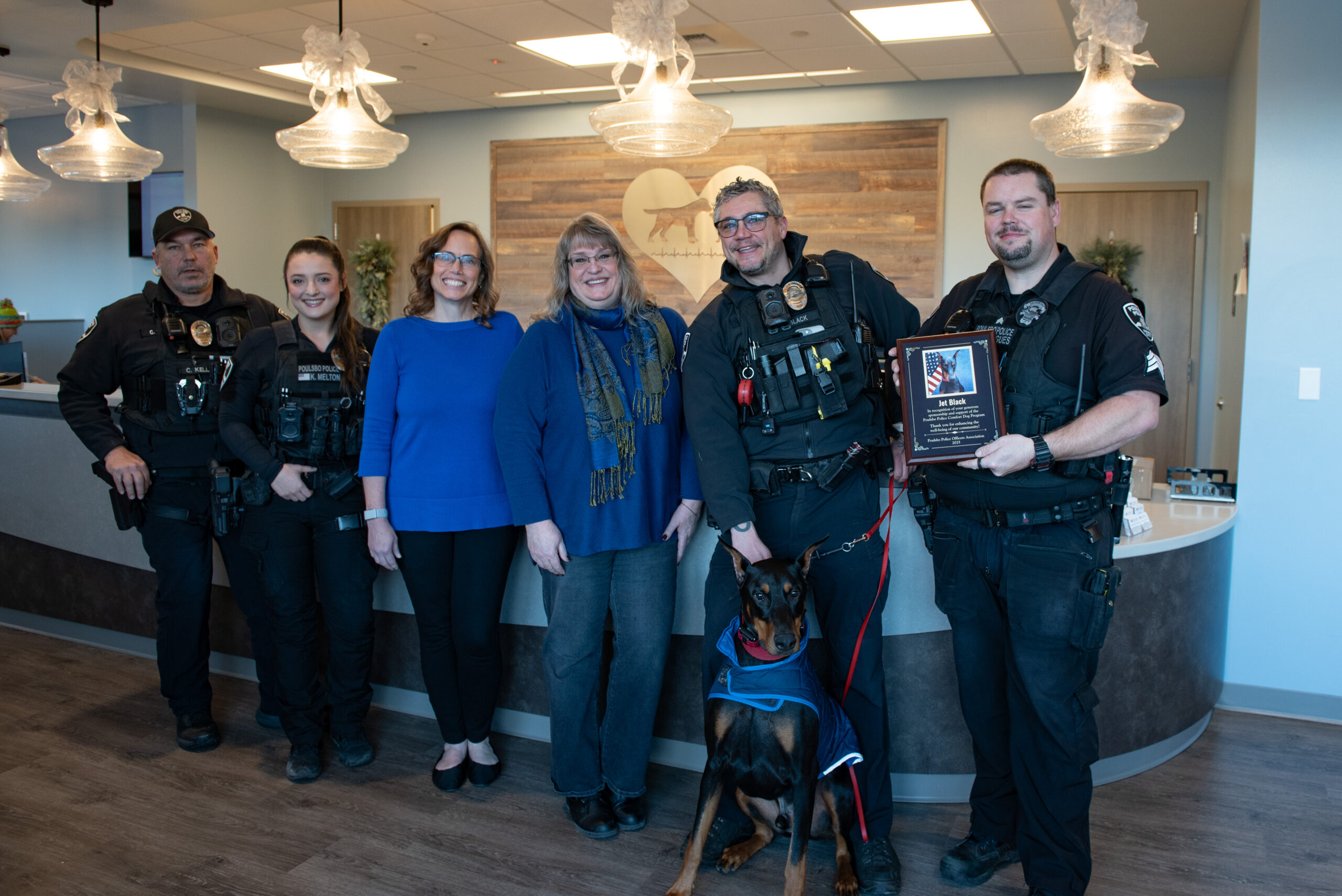
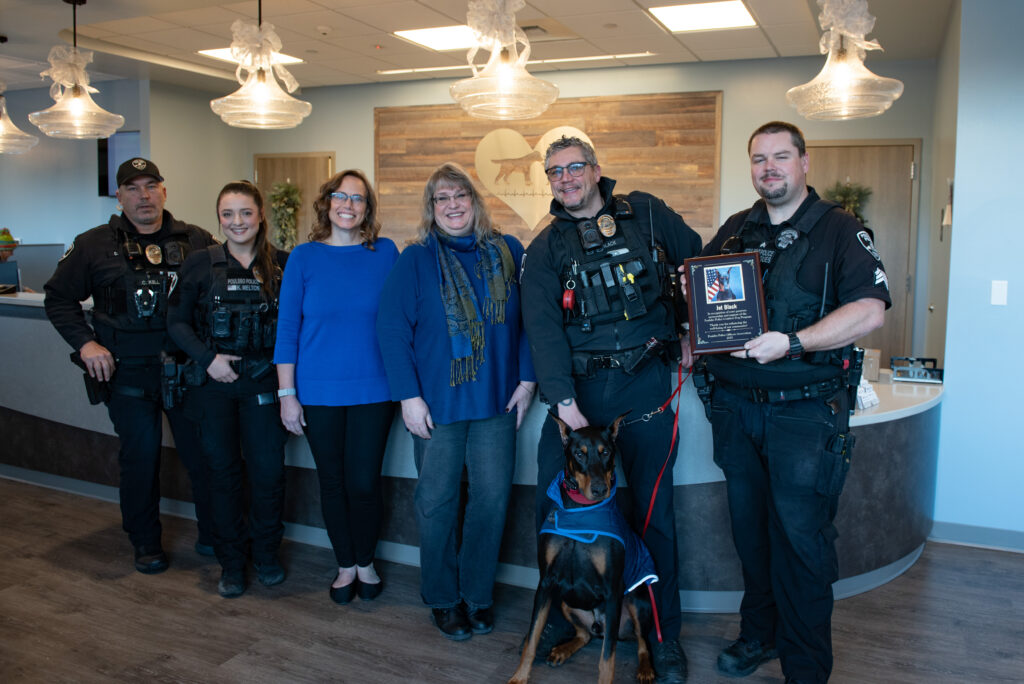
Jet is the Poulsbo Police Department’s comfort dog, a role that puts him in classrooms, school hallways, community events, police offices, and sometimes the quiet corners where stress, fear, or grief linger. Keeping him healthy, fueled, and ready for that work is Animal Emergency & Specialty Center (AESC) in Poulsbo, which sponsors Jet’s veterinary care.
That sponsorship means AESC provides all of Jet’s physical exams, vaccines, medications, preventatives, and food at no cost to the City of Poulsbo or to Officer Justin Black, Jet’s handler and the architect of the department’s comfort dog program.
For Diane Gates, Leadership Administrator at Animal Emergency & Specialty Center, the partnership is less about visibility and more about values.
“This is our community,” Gates said. “We’re all pet owners and pet parents, and we want people who care about the community handling our pets. We want them to treat them the way we treat our babies at home.”
A Familiar Role: Caring for Police Canines
Jet isn’t the first police dog AESC has supported. The hospital previously sponsored Kilo, a former Poulsbo police canine who became part of the hospital’s culture.
“When Kilo was our dog, we even used his name as our security word,” Gates said. “If somebody said, ‘Hey, we need to page Dr. Kilo,’ that meant call 911, because something was wrong.”
The connection to Jet came almost by accident. Gates met Officer Black and Jet at PetsWALK, a Kitsap Humane Society fundraiser, where both were scheduled to speak.
“He had to get up and give a speech, and I had to follow him,” Gates said. “Who wants to follow the dog and the policeman, right?”
As they waited, Gates began asking practical questions: Who was sponsoring Jet? Who covered his vaccines, food, and emergency care?
The answer was simple. Black was covering it himself.
“I said, ‘Well, here’s my card. Let’s talk. Let’s see what we can come up with,’” Gates said.
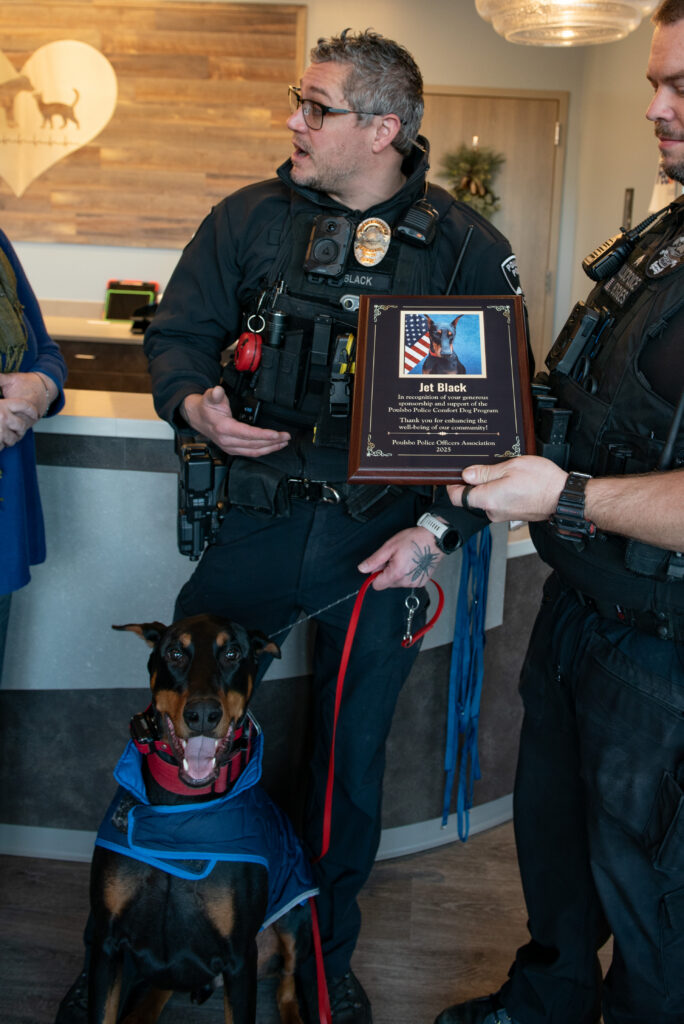
The result was a comprehensive sponsorship. AESC covers Jet’s annual exams, vaccines, blood work, all preventatives, and his food. If Jet ever needs emergency care, the hospital waives the exam and emergency fees and provides a 25% discount on all services.
For Black, who personally pushed to create and launch the comfort dog program, that support meant more than financial relief.
“I don’t like handouts,” Black said. “But they set it up in a way that felt really community-oriented. It didn’t feel like I owed them something. It felt like they cared about Jet, and about what he represents for the department and the city.”
Care Built for a Working Dog
Jet’s job sets him apart from most patients. He’s not just a pet; he’s a working police dog and a community therapy dog, with physical and emotional demands that require thoughtful planning.
When Jet first came to AESC, Medical Director Dr. Michael Stone became his primary veterinarian.
“He went over everything with Justin about what Jet does in a day, what his activity level is, what his needs were,” Gates said. “We adjusted his diet appropriately so that he wasn’t getting too much protein, but enough protein.”
Preventative care is tailored as well. Because Jet may interact with other dogs from different areas and environments, the team considers additional exposure risks when designing his vaccine and preventative schedule.
“Keeping the vaccines up to date is really important,” Gates said. “His diet and preventatives, making sure he gets his annual exams and anything that comes up is seen immediately — those are all key.”
Jet is young and healthy now, but AESC is prepared to adapt his care as he ages or as his role evolves.
Breaking the Cycle of Stress
Jet’s role is simple to describe but powerful in practice: he disrupts stress.
“First responders, especially cops, are alone a lot,” Black said. “We’re in our cars, in our heads, going from call to call. You don’t realize how long you’ve been stuck in your own thoughts. Jet forces you to stop. He’ll knock the phone out of your hand, sit in your lap, nudge you until you engage. It gives you that second of clarity you didn’t know you needed.”
That impact isn’t theoretical. Black recalls one moment inside the department that crystallized Jet’s value.
A front desk employee, a former dispatcher with significant PTSD, was having a particularly hard day.
“No one was really paying attention, but Jet knew right away,” Black said. “Next thing I know, he’s in her lap. I’m wondering where the dog went, and he’s just been lying on her for however long. That was really powerful.”
In schools, Jet has become a bridge to students who often keep adults and especially police at arm’s length.
“The biggest impact has been with what you’d call the ‘problem kids’—the ones with a stack of disciplinary reports,” Black said. “I’m a cop, I look like one, and you don’t expect those teenagers to open up to an officer. But they’re drawn to the dog, not me. Jet gets them in the door, and then they start talking. You realize they’re really just looking for discipline, boundaries, and positive attention.”
A Doberman with a Message
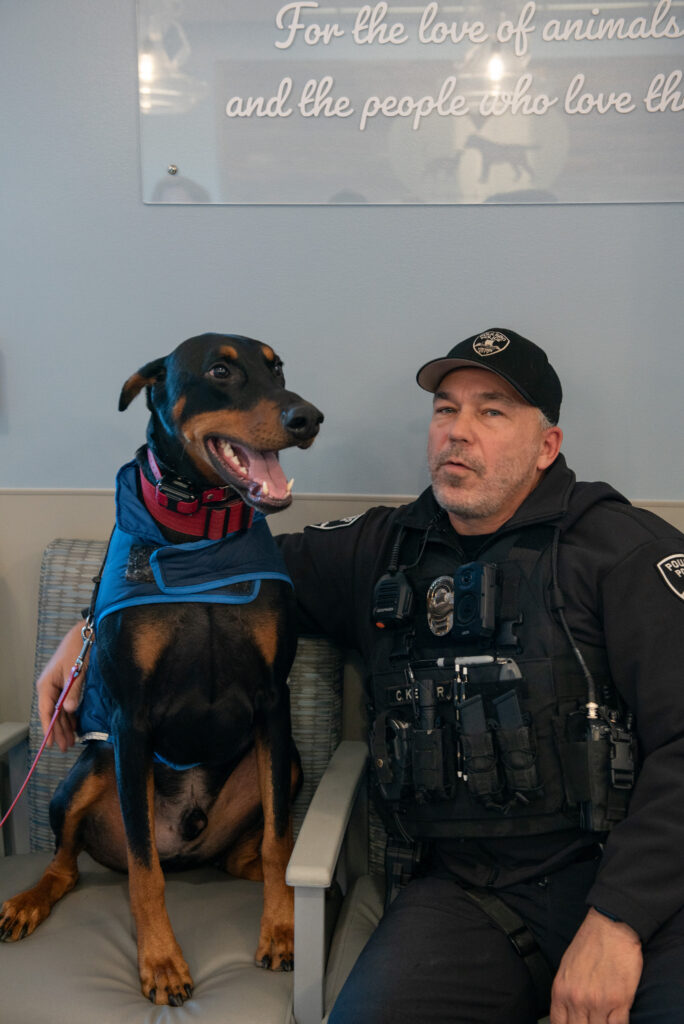
Jet’s breed was a deliberate choice. Black wanted a dog that visually aligned with law enforcement.
“I wanted something a little more representative of law enforcement,” he said. “Dobermans were bred for personal protection, they’re very focused on their person.”
What surprised him was Jet’s personality.
“What I didn’t realize was how touchy-feely and affectionate they are. If I’d known that, I might’ve picked a golden retriever,” he joked.
Gates admits she had her own assumptions.
“I was surprised that a Doberman was chosen,” she said. “But when you meet Jet, you instantly forget he’s a big, scary Doberman. He’s just like, ‘Hey, I’m your new best friend.’”
That contrast is part of Jet’s power. His presence changes the emotional temperature of a room and reshapes how people, especially kids, see police.
Where there were once whispers of “Uh oh, cops are here,” Black now hears, “Go say hi to Officer Black,” or simply watches a line form to pet Jet.
“They don’t care about me,” Black said, laughing. “They’re not mean, they just don’t have any reason to come talk to a 40-year-old cop at school. But they will absolutely go out of their way to see the dog. That opens the door for conversations that never would have happened.”
Building the Program from the Ground Up
The comfort dog program didn’t come easily. When Black first proposed the idea, the department’s insurance carrier issued a firm rejection.
“I wrote the entire policy, laid out the program, documented why it would be good,” Black said. “Then I had the rebuttal sessions: ‘What if this happens? What if that happens?’ We just went down every rabbit hole and dug our way out.”
During that year-long process, Black personally covered Jet’s costs and invested hundreds of hours into training. AESC’s partnership eased that burden and sent a signal that the broader community believed in the program.
“For me, their support makes it real,” Black said. “It makes it real for my chief, for the department, even for my family. Instead of putting money into food and basic care, I can put resources into better training or tools that help Jet do his job.”
Business with a Community Heart
Supporting Jet fits into a broader pattern of community involvement for Animal Emergency & Specialty Center. The hospital sponsors PAWS of Bainbridge and North Kitsap, Kitsap Humane Society, and a Bainbridge-based assistance dog organization. Staff regularly participate in events like PetsWALK and Poulsbo’s Viking Fest parade.
“We grow, but we’re a small community in our hearts,” Gates said. “You have to have that feeling of being a trusted friend who just happens to run a vet hospital, who can help you in an emergency. That’s how we want to live, and that’s how we want to do business.”
Gates sees the police canine partnership as a reflection of shared values.
“They’re really interwoven with us,” she said of Jet and Officer Black. “They’re great spokesmen for us, because they show the kind of care that we give and that we walk the walk. We’re not here for the money. We’re here because we care about our patients and our community’s patients.”
Changing How Care Looks
The partnership between Jet, the Poulsbo Police Department, and Animal Emergency & Specialty Center reflects a broader shift in how communities think about wellness—both human and animal.
“We’re so focused on the job that we forget to take care of ourselves,” Black said. “Jet is a stark reminder that we need to. Just seeing him unconsciously pushes us to consider our own well-being.”
“I think there should be one ( comfort dog) in every cop car,” he said. “These dogs break down barriers. People see the uniform and assume tragedy or conflict. But most of the officers I work with—some of them are huge, intimidating-looking people—are the sweetest, most caring people you’ll ever meet. Jet gives the community a reason to approach us and find that out.”
For now, Jet continues his daily work: greeting kids at school drop-off, decompressing officers after long shifts, and quietly anchoring people in moments when they need it most. Behind the scenes, a local specialty hospital ensures he’s healthy, strong, and ready for the next call.
“He gets the assignment,” Black said. “And honestly, he’s changing how I see this job and how the community sees us.”
Keep in touch with our news & offers
Subscribe to Our Newsletter
Thank you for subscribing to the newsletter.
Oops. Something went wrong. Please try again later.